 AML
AMLYour exchange will screen this transfer —
right after it freezes it.
One "dirty" USDT and the exchange freezes your deposit, not the sender's. We query independent sources and give a direct verdict in 10 seconds: accept, ask for a different wallet, or decline.
Check a USDT (TRC-20), BTC, ETH, SOL or TON address for OFAC sanctions and Tether/Circle blacklists — no wallet connection.
Freezes and sanctions — in real time.
addresses under OFAC sanctions and fresh Tether freezes. The feed rises from the bottom up — hover to pause it and copy an address.
Whale Watch — large and sanctioned transfers in real time.
An open terminal: flows across 14 chains, flags for sanctions / mixers / freezes, address breakdown and a connections graph. No login.
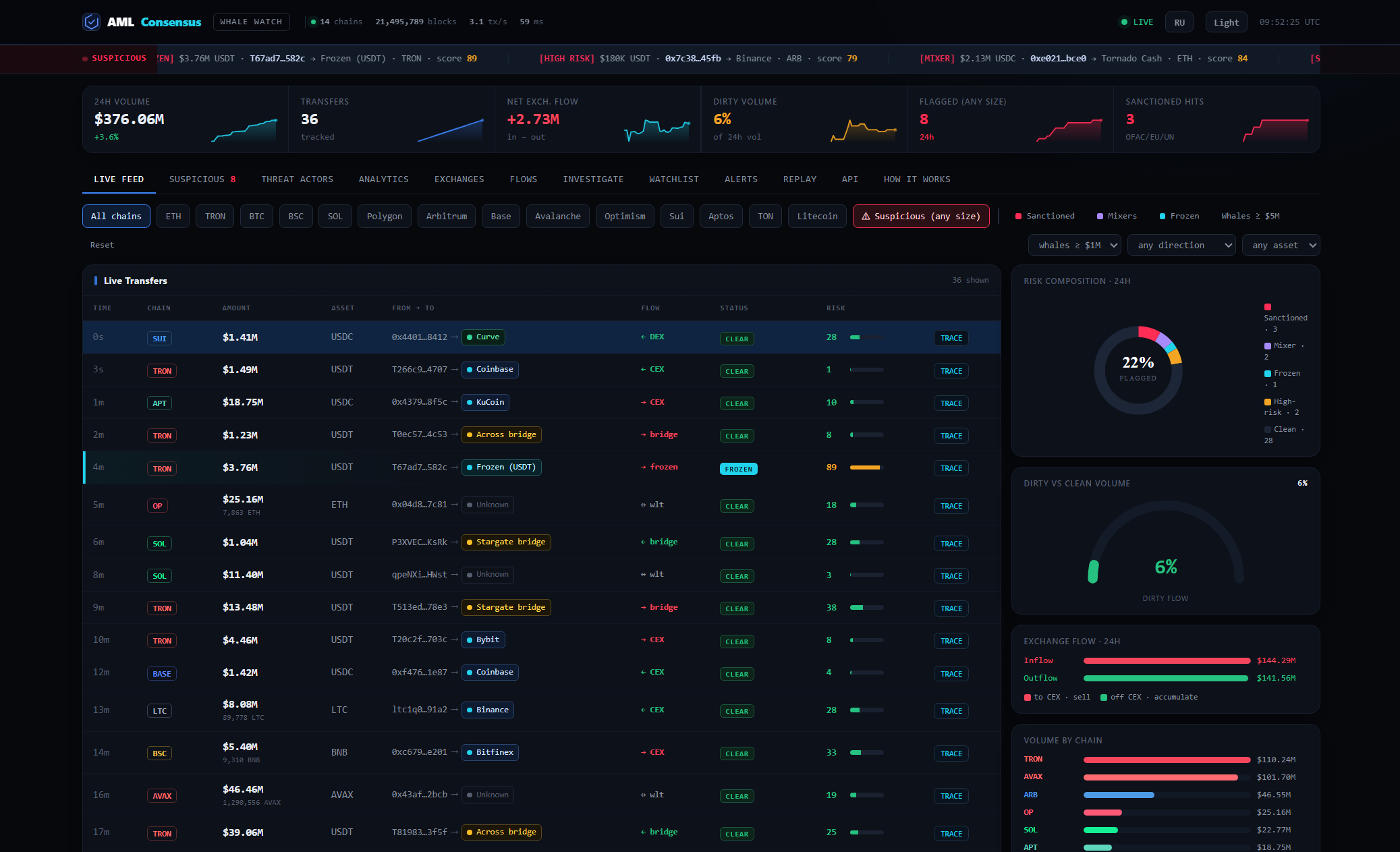 14 chains · sanctions / mixers / freezes · connections graph · address breakdown
Large transfers and suspicious ones of any size; sanctions, mixers and freezes are flagged explicitly. Break down any address, an interactive connections graph, report export. Live feed: ETH and TRON from $500k in real time; Analytics, Threat Actors and Replay panels are illustrative.
Three levels of protection in one service.
From an instant verdict to a full investigation of a wallet's history across 35+ networks.
Source consensus
Not one database, but 4 independent sources at once — OFAC sanctions lists, the Chainalysis sanctions oracle, TRM Labs sanctions screening, and on-chain Tether/Circle blacklists. Each is shown separately in the report.
Why this is more accurate →Full investigation
An audit of all activity: history across networks, counterparty attribution, exposure by category (mixer/darknet/scam) in USD, tracing to cash-out, and typologies.
How the audit works →Monitoring and graph
Put an address under watch — a Telegram alert if its risk rises or it lands under sanctions. The connections graph shows counterparties across 35+ networks.
More than a check →Why we're not "just another AML bot".
Most bots resell a single database and show one number. We show a consensus — and explain it.
4 sources
OFAC, Chainalysis, TRM Labs, and on-chain Tether/Circle blacklists — each shown separately in the report.
A verdict for P2P
Not "43% risk", but an answer: accept the transfer or not. Thresholds tuned to how MEXC, BingX, HTX, and Bybit actually behave.
PDF report with QR
The QR links to a live copy of the report — your counterparty can confirm the document isn't forged.
Monitoring
A Telegram alert if the risk rises or the address lands under sanctions. Clean yesterday ≠ clean today.
Honest billing
If there's no deep data, we give a partial report and don't charge a check. We never invent a score.
Checks never expire
Your package stays forever, with no subscription traps. Plus 1 free check per month.
10 seconds, no login
Send the address — the network is detected automatically. Pay by card/Stars or crypto in a minute.
17 networks
One check across 17 networks — EVM chains, Bitcoin, TRON, Solana, TON and XRP. Same verdict, cross-chain.
Connections graph and live fund tracing.
We follow the flow of money along the chain — from a counterparty's address to risky points and the cash-out.
Full audit of the source of funds.
We calculate exposure by category — how much of the turnover is tied to mixers, darknet, or sanctions — and trace it to the final cash-out.
Multi-hop
Up to 5 hops: we find sanctions, mixers, and thefts deep in the chain.
Withdrawal points
Where the funds go — the likely cash-out to fiat on an exchange.
USDT/USDC freeze
An on-chain check for an issuer block — something many services lack.
How to read the verdict.
Each exchange sets its own risk threshold and doesn't publish it — so we give a conservative recommendation.
How we beat standalone analyzers.
Services in aggregators give a report from a single database. We build a consensus and hand you a ready verdict.
| Capability | AMLConsensus | Standalone analyzers |
|---|---|---|
| Number of sources in the report | 4 · consensus | 1 database |
| Supported networks | 17 verdict · 35+ graph | 3–9 |
| Ready verdict for P2P | yes | usually just a score |
| Check by transaction hash | yes | some |
| Source-of-funds breakdown in % | yes | some |
| Full activity audit | yes · EVM/TRON/SOL | rarely |
| Connections graph across 35+ networks | yes | 3–9 networks |
| QR verification of the report | yes | almost none |
| Transparent pricing | from $0.45 | varies |
Open methodology, QR-verifiable reports, a public security.txt. Everything we claim is verifiable.
Why this is safe.
We physically cannot access your funds — and here's why.
No wallet connection needed
We never ask for Connect Wallet, a seed phrase, a private key, or a signature — only the public address: the 40 characters you already give your counterparty.
Zero transaction signatures
We don't call smart contracts and never ask you to sign anything. Security extensions find no hidden calls with us.
Open methodology
We publish how the risk is calculated and let anyone verify a report's authenticity by QR. We have nothing to hide.
A public address is all a check needs. If a site or bot demands "Connect Wallet", a transaction signature, or a seed phrase "for the check" — it's almost always a drainer: connecting a wallet on an untrusted resource gives the scammer access to your funds, and they'll drain them. We ask only for an address or a transaction hash — nothing that grants access to your money.
We don't walk away after the verdict.
Address monitoring
Put it under watch — we'll send an alert if the address turns risky. Enable it in the bot →
Help with a freeze
We'll assemble an appeal package: a report and an explanation of the source of funds. How to unfreeze →
@amlconsensus subscribers get 1 free check every month, early access to promotions, and breakdowns of real freeze cases.
Freeze breakdowns and AML guides.
Practical articles for P2P traders, merchants, and exchangers. Quick updates go out on the @amlconsensus channel.
Blockchain detective: 3 real wallets — from Vitalik to Lazarus hackers
We took three real addresses and ran them through an AML check: a clean wallet, a deposit with a sanctions trail, and money from North Korean hackers.
The exchange froze my crypto: why it happens and what to do in 2026
The real reasons behind freezes, retroactive blocks, and a step-by-step plan: how to get your funds back and how to avoid it in the future.
How to check USDT (TRON, TRC-20) for cleanliness before P2P
USDT on the TRON network is the main freeze zone. Step by step: how to check a TRC-20 address for a dirty history and sanctions in 10 seconds.
How to check a crypto address against OFAC sanctions — free in 10 seconds
OFAC sanctions mean a 100% freeze on any exchange. What the SDN list is and how to check a BTC/ETH/USDT/TRON/SOL address for free.
Wallet connections graph: how to see where the money came from and went
The graph shows a wallet's counterparties across 35+ networks: nodes colored by risk, edges by amount. How to read the graph and spot mixers.
Full crypto wallet audit: an investigation across 35+ networks
Not just a risk score, but a full investigation: history, counterparty attribution, exposure by category in USD, tracing, and typologies.
First 30 customers — −25% forever on all checks
Make your first paid check and leave a short review — we lock in −25% on your whole account, for life. Plus a spot on the list of first partners.
Pay in a minute. Checks never expire.
Your first check is free. Pay by card/Apple Pay via Telegram Stars, or with crypto.
Pay in USDT or USDC — TRON (TRC-20), BNB Chain, Base, Arbitrum. Checks are credited automatically, usually within a minute.
Need more than 200 checks or an API? Plans for merchants and exchangers.
What else there is, and what it costs.
Subscriptions are billed separately. Everything else comes off the same check balance.
Subscriptions
From your check balance
Free, no sign-up
Exchangers and merchants — API from $0.08 per check. Channels and P2P teams — partner programme.
Frequently asked questions.
Why check a wallet before a P2P deal?
Exchanges automatically analyze the origin of incoming crypto. If a counterparty sent funds tied to darknet, scam, or sanctions, they'll freeze your deposit, not theirs. A check takes 10 seconds; unblocking takes weeks.
Do I need to connect a wallet for the check?
No — and don't agree to it anywhere. A public address or transaction hash is all an AML check needs. If a site demands that you connect a wallet (Connect Wallet), sign a transaction, or enter a seed phrase "for the check" — that's a sign of a drainer that can steal your funds. Connecting a wallet on an untrusted resource is especially dangerous. We accept only an address — nothing that grants access to your money.
Where does the data come from? Why should I trust you?
OFAC sanctions (refreshed every 3 hours straight from the OFAC list), the Chainalysis sanctions oracle and TRM Labs sanctions screening, Tether/Circle blacklists (read straight from the contracts), and MistTrack graph analytics. Our methodology is published.
Why do you and another service show a different risk score?
Everyone's labeling databases differ — which is why we show a consensus of several sources rather than a single number. Hard facts (sanctions, a freeze) don't depend on any service's "opinion".
Which networks are supported?
A full verdict — across 17 networks (BTC, ETH, TRON, Solana, TON, BNB, Polygon, Base, Arbitrum, Optimism, Avalanche, Plasma, LTC, BCH, DOGE, DASH, XRP). Breakdown, graph, and audit — 35+ networks.
Which exchanges are the verdicts calibrated to?
To the freeze practices of MEXC, BingX, HTX, Gate, KuCoin, Bitget, CoinEx, and Bybit. Each has its own threshold, so the recommendations are conservative.
What does "the report is verifiable" mean?
Every report has a unique number and a QR code. By scanning it on the verification page, anyone gets a live copy from the database. A forged PDF won't pass.
Does a check guarantee the exchange won't freeze the funds?
No. We show the publicly known risks at the moment of the check — this dramatically lowers the chance of trouble, but the exchange makes the final call.
Do you store my data?
Only your Telegram ID, check history, and monitored addresses — that's needed for the service to work. We don't link addresses to identities and don't share data with third parties.
Your first check is free.
Paste an address or transaction hash. A direct verdict in 10 seconds, a plain-language breakdown, and a connections graph.